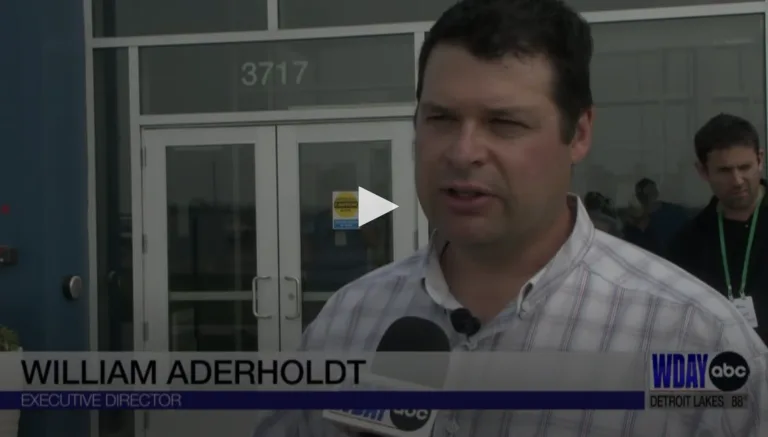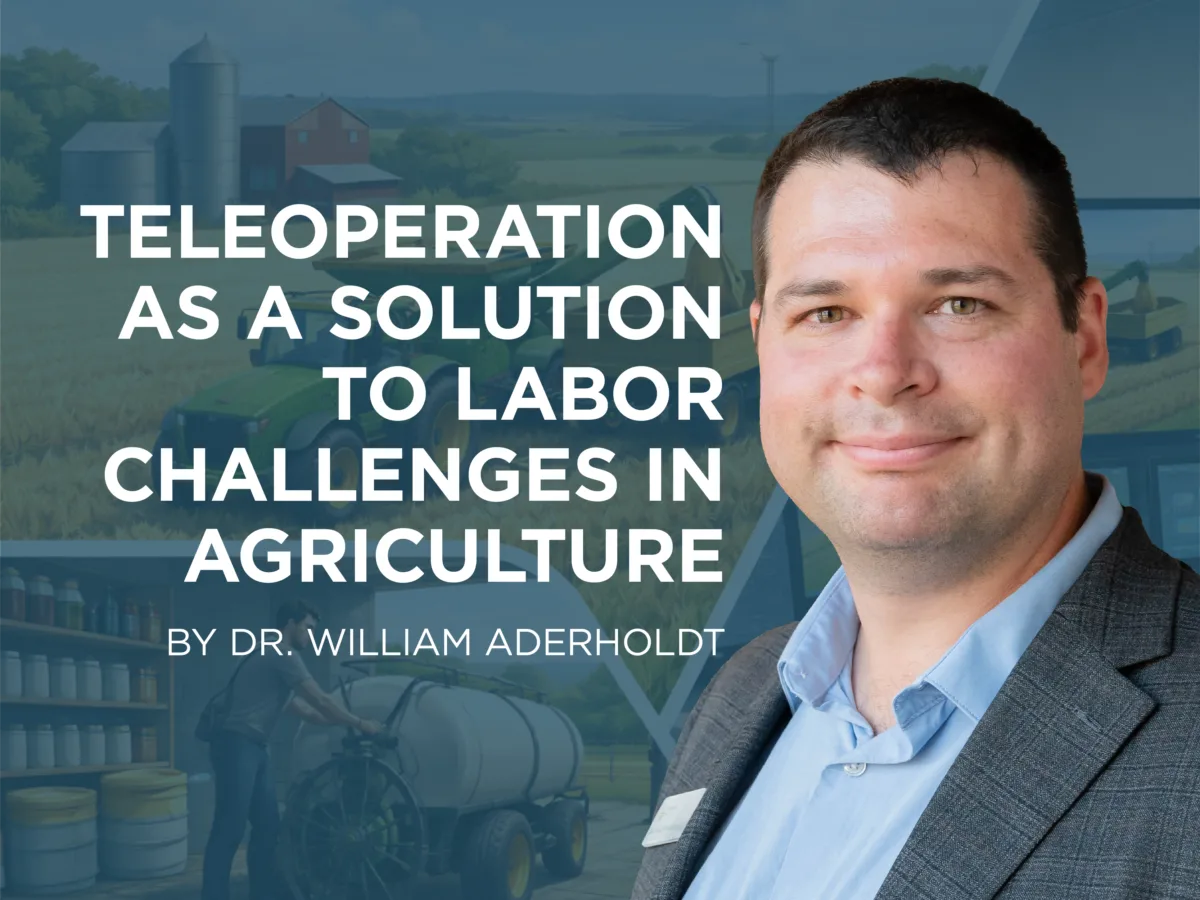
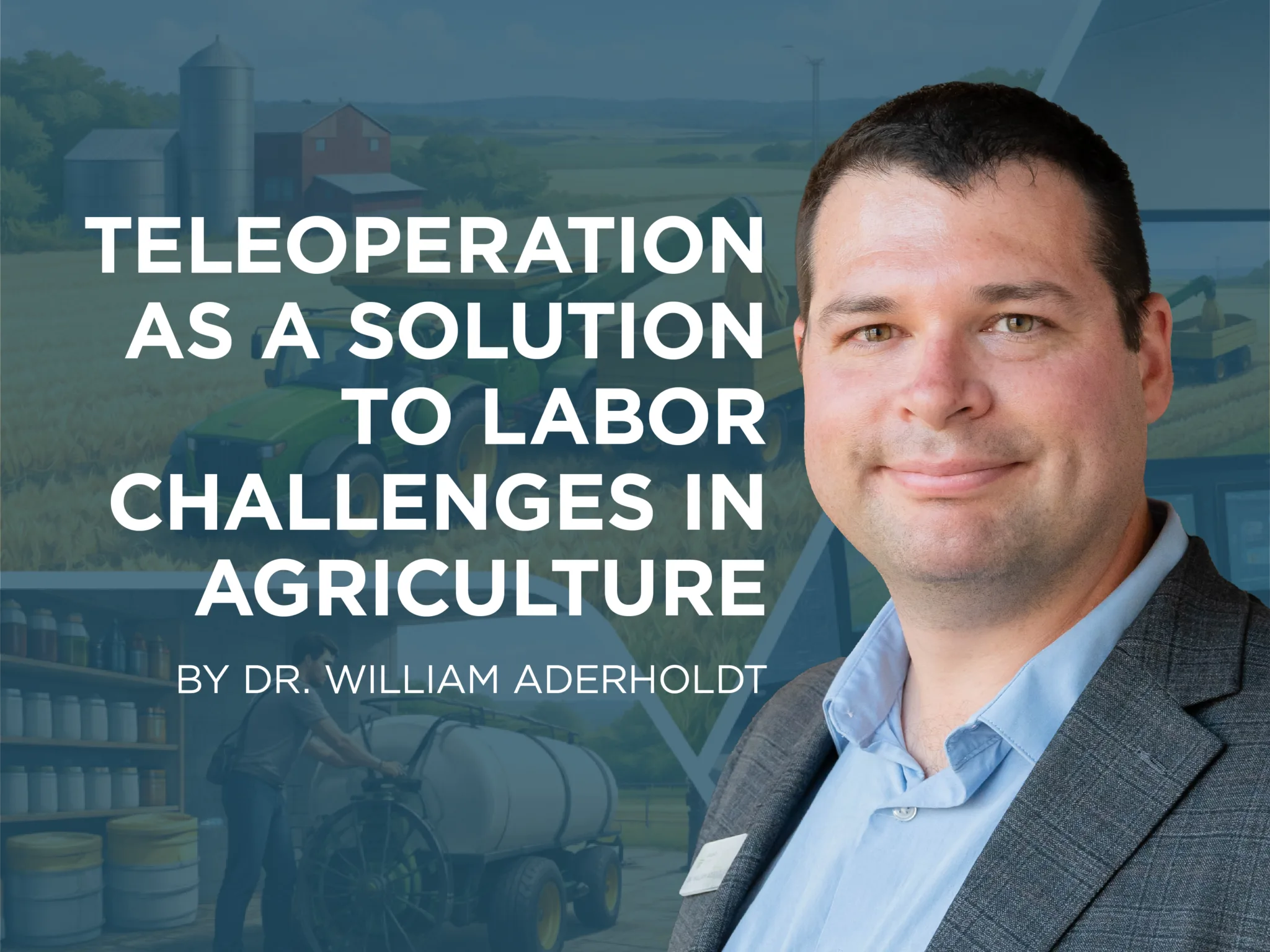
Dr. William Aderholdt serves as Executive Director of Grand Farm, a collaborative network advancing agriculture through applied technology. The views expressed in his writing are his own and do not necessarily reflect the positions of Grand Farm or its partners.
Agriculture is facing a labor challenge. That is not new.
What is changing is the nature of the constraint.
Across the United States and globally, labor is becoming harder to access, more expensive to mobilize, and increasingly misaligned with when and where work needs to happen. The traditional response has been to build systems that move people to the work through seasonal labor, housing, transportation, and complex coordination.
That model is under strain.
At the same time, we are seeing rapid advancement in artificial intelligence, robotics, and communications infrastructure. These technologies are often framed as a path to full autonomy. But there is an important step in between that deserves more attention.
Teleoperation.
Not as a replacement for people, but as a new way to deploy them.
Rethinking Where Work Happens
At its core, teleoperation allows a person to operate equipment remotely using connected systems, sensors, and cameras. In agriculture, that could mean running a grain cart during harvest, operating a sprayer, or supporting logistics from a distance.
This creates the opportunity to rethink a foundational assumption.
Instead of moving people to the work, we can begin to move machines and allow the labor to remain where it is.
This is not just a technical shift. It is an operational one.
A Hybrid Model, Not a Binary One
It is important to be clear about what teleoperation is and what it is not.
It is not a replacement for autonomy.
It is not a replacement for on-farm labor.
And it does not apply evenly across all agricultural tasks.
The most immediate opportunities are in structured, repeatable environments. Tasks like grain handling, spraying, and tillage are more predictable and can be supported with today’s technology. More complex tasks, especially those requiring fine dexterity or operating in highly variable conditions, will take longer to scale.
What begins to emerge is a hybrid model.
Autonomy handles the repeatable portions of work.
Humans step in when judgment, intervention, or safety is required.
This approach allows systems to operate more consistently while still maintaining human oversight where it matters most.
The Role of the Farm Does Not Disappear
As we think about remote operation, it is critical to stay grounded in the realities of the farm.
Agriculture is a physical system.
Machines need to be fueled.
Inputs need to be loaded.
Equipment needs to be maintained and staged.
These functions do not go away.
What changes is how labor is organized around them.
Instead of distributing people across the field, we begin to see a more centralized on-site role. Someone at the farm shop or homestead is responsible for preparing equipment, managing inputs, and ensuring that operations can continue without interruption.
Around that role, a distributed layer of remote operators supports the active work in the field.
One person on-site. Multiple operators off-site; perhaps supporting multiple farm operations simultaneously.
This is not about removing labor. It is about multiplying its impact.
From Labor Constraint to Utilization Opportunity
Framing this shift as a labor solution misses the larger opportunity.
This is about utilization.
Today, machines are often constrained by the availability of local operators. When that constraint is removed, equipment can run longer hours, operate across time zones, and be supported by a broader pool of skilled workers.
This changes the economics.
The system begins to work when operators can support multiple machines or when machines can operate closer to continuous use. It also opens the door to more specialized roles, where individuals develop expertise in specific crops, systems, or tasks.
Over time, this leads to a more professionalized and distributed agricultural workforce.
Seasonality and Scale
Agriculture has always been defined by seasonality. Historically, that has required labor to move with the work.
Teleoperation creates the potential to decouple those two.
Machines can move between regions and production cycles.
Operators can remain in place.
This introduces the possibility of balancing labor across geographies, increasing both workforce stability and equipment utilization. It also creates new challenges in coordination, training, and system design, all of which need to be addressed deliberately.
Teleoperation as a Pathway to Autonomy
There is another important dimension to this model.
Data.
Every teleoperated action generates insight into how work is performed under real-world conditions. Each adjustment, correction, and decision becomes a signal that can be used to improve autonomous systems.
In this way, teleoperation is not just an operational tool. It is part of the learning system that will enable more capable and reliable autonomy over time.
What This Means for the Future of AgTech
Teleoperation will not be the final state of agricultural systems.
But the transition to that future will not happen all at once.
Teleoperation provides a practical and immediate pathway to:
- deploy advanced capabilities today
- address current workforce constraints
- generate the data needed to improve autonomy
- and build trust in these systems over time
It also has implications for how machines are designed, how infrastructure is built, and how workforce systems are developed.
This is not a single technology shift. It is a systems shift.
A Different Framing
Agriculture will continue to ask how to solve its labor shortage.
But that question assumes labor must be physically present to create value.
A more useful framing is this:
How do we build systems where location is no longer a requirement for contribution, while still supporting the physical realities of the farm?
That is the challenge in front of us.
And it is one that will define how agricultural systems evolve in the years ahead.