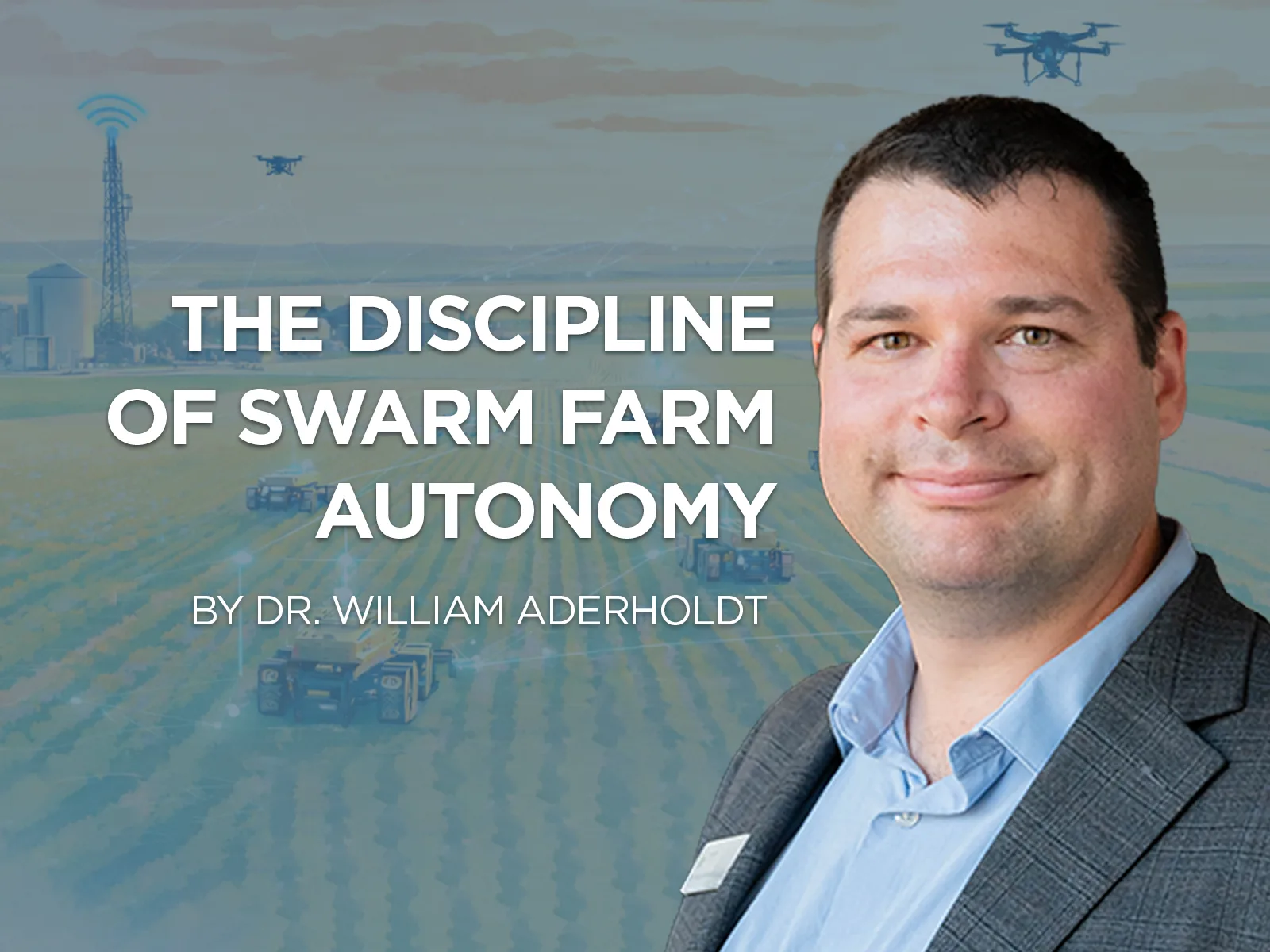
Dr. William Aderholdt serves as Executive Director of Grand Farm, a collaborative network advancing agriculture through applied technology. The views expressed in his writing are his own and do not necessarily reflect the positions of Grand Farm or its partners.
Agricultural autonomy will not scale because one robot works.
It will scale when coordinated swarms operate reliably across an entire season.
The conversation around agricultural robotics often focuses on individual machines. A weeding robot. An autonomous tractor. A robotic sprayer.
That framing is incomplete.
The real transformation is not single-machine autonomy. It is swarm coordination. Multiple autonomous units operating simultaneously, sharing state, distributing workload, and adapting dynamically to field conditions.
But swarms introduce a different level of complexity.
If one machine fails, it is an incident. If a swarm behaves unpredictably, it is systemic risk.
That is why reliability must precede scale.
Swarm Autonomy Changes the Risk Equation
A single machine making autonomous decisions is already complex. A swarm multiplies decision density exponentially.
Each unit is making thousands of micro-decisions per hour. Now multiply that by ten, twenty, or fifty machines operating simultaneously.
The governing logic becomes:
Error Frequency × Error Severity × Volume × Fleet Size
In swarm systems, coordination errors can compound. Overlap. Missed zones. Traffic congestion. Resource misallocation. Battery mismanagement. Conflicting task execution.
Agriculture does not punish minor inefficiency. It punishes high-severity failure during narrow operational windows.
Planting delayed by days. Harvest disrupted during optimal moisture conditions. Chemical misapplication events.
Swarm autonomy cannot be evaluated by average accuracy. It must be evaluated by severity containment and coordinated recovery.
The question is not whether a swarm can operate. It is whether it can fail gracefully.
Phase 1: Single-Task Robotics
The industry is largely here today.
Robotics perform discrete tasks under significant operator supervision. A weeding unit handles row-level precision. A drone scouts for anomalies. An autonomous tractor operates within tightly defined boundaries.
These systems are valuable. But they are not swarms.
Risk is localized. Coordination demands are limited. Hardware durability is still the primary constraint.
This phase is about proving mechanical survivability and task reliability.
Without full-season durability, swarm conversations are premature.
Phase 2: Coordinated Multi-Unit Operations
Phase two begins when multiple autonomous units operate simultaneously within a shared field environment.
This is where swarm logic begins to emerge.
Machines must share:
- Completed work zones
- Active task assignments
- Obstacle awareness
- Soil and environmental data
- Equipment health status
This requires resilient last-acre connectivity and structured data exchange.
Mesh networking, satellite backhaul, and edge computing become foundational. Without real-time state synchronization, swarms fragment into isolated machines.
At this stage, orchestration is more important than intelligence. Shared awareness reduces redundancy and compresses severity exposure.
Phase 3: Trust Shift and Capacity Distribution
Once coordinated operations prove reliable across full seasons, the trust model begins to shift.
Instead of concentrating capacity in one or two large machines, workload can be distributed across a fleet of smaller units.
This is where swarm autonomy begins to change farm architecture.
If one unit fails, capacity degrades incrementally rather than catastrophically. The system continues functioning. This is distributed resilience.
However, redundancy only works if orchestration prevents congestion and inefficiency. Poorly coordinated swarms increase compaction and operational noise. Well-coordinated swarms increase fault tolerance.
Phase three is not about eliminating conventional equipment entirely. It is about reducing dependence on single points of failure.
Trust in predictable recovery becomes the threshold variable.
Phase 4: Continuous Swarm Operation
In this phase, swarms operate continuously across the farm.
Task allocation becomes dynamic. Units respond to localized weed pressure, disease emergence, soil variability, and growth stage differences in real time.
This shifts agriculture from coverage-based field passes to density-based intervention.
Instead of treating 1,000 acres uniformly, the swarm allocates effort proportionally to risk and opportunity.
Decision density per acre increases dramatically.
This phase requires mature orchestration, robust infrastructure, and disciplined severity tracking. The system must log, adapt, and escalate when anomalies occur.
Continuous swarm operation is not about spectacle. It is about micro-optimization across space and time.
Phase 5: Structural Reconfiguration
Only after reliability and orchestration discipline are proven does structural transformation become viable.
Large-scale equipment such as the combine has historically dictated farm geometry, compaction patterns, and capital allocation.
Swarm robotics introduces a long-term opportunity to rethink that structure.
Smaller coordinated harvest units could reduce concentrated axle loads. Traffic patterns could become more flexible. Sub-field resolution could increase.
This is not an immediate transition. It is a structural evolution.
But it represents the first credible pathway toward reconfiguring farm architecture around distributed systems rather than throughput concentration.
Swarm autonomy is not simply automation. It is architectural redesign.
Why Discipline Matters
It is tempting to jump from phase one to phase five in narrative.
The industry often does.
But scale without reliability introduces systemic exposure. Swarms amplify both efficiency and failure.
That is why sequencing matters:
- Hardware durability across full seasons
- Resilient last-acre connectivity
- Structured multi-unit orchestration
- Severity-weighted reliability metrics
- Demonstration environments that prove coordinated recovery
Evidence must precede evangelism.
The Cultural Dimension
Swarm robotics also challenges agricultural identity.
Farmers are accustomed to visible horsepower. Large equipment represents scale and capability. Swarms replace concentrated machinery with distributed intelligence.
That shift requires trust.
Dealer networks, financing models, insurance frameworks, and service ecosystems must adapt alongside technology.
If swarm systems reduce cognitive burden and increase operational resilience, adoption accelerates. If they introduce monitoring overhead and technical complexity, resistance increases.
Adoption velocity is a function of:
Swarm autonomy must satisfy all three.
The Path Forward
The future farm will likely be orchestrated rather than individually mechanized. Distributed rather than concentrated. Adaptive rather than uniform.
But that future will not be achieved through acceleration alone.
It will require disciplined progression through phases. Full-season swarm demonstrations. Transparent severity metrics. Infrastructure investment. Structured interoperability standards.
Swarm robotics has the potential to increase resilience, reduce compaction, improve input precision, and reconfigure farm architecture over time.
But only if reliability comes first.
Scale is not the starting point.
Reliability is.