Keep up with the Grand Farm Innovation Campus this growing season! Our new Weekly Email Series "What's New at the Farm" posts every Monday!
Sign up now
Technology
Crop
Location
Timeline
Website
On this page: The Challenge | The Approach | The Outcomes | Looking Ahead
Modern agriculture is under increasing pressure to improve nutrient efficiency while reducing inputs and environmental impact. Traditional fertilizers often face limitations such as soil nutrient tie-up and the risk of crop tissue damage from foliar applications.
In the Red River Valley, Iron Deficiency Chlorosis (IDC) is a persistent challenge in soybeans, reducing yield and appearing inconsistently across fields, making it difficult for growers to manage effectively. A key limitation of existing foliar solutions is that nutrients applied as reactive ions can become immobilized near the point of contact, limiting their movement within the plant and reducing their impact on new growth and overall yield.
Prospect Growth is addressing this issue with nanoparticle-based fertilizers, a new class of ultra-small, solid, water-dispersible particles that deliver nutrients in a non-ionic form. Due to their small size, these particles can enter plant tissues and release nutrients gradually, helping reduce loss pathways while improving alignment between nutrient supply and crop demand. Testing this technology in North Dakota is critical to validating performance in a region where IDC is both common and economically significant.
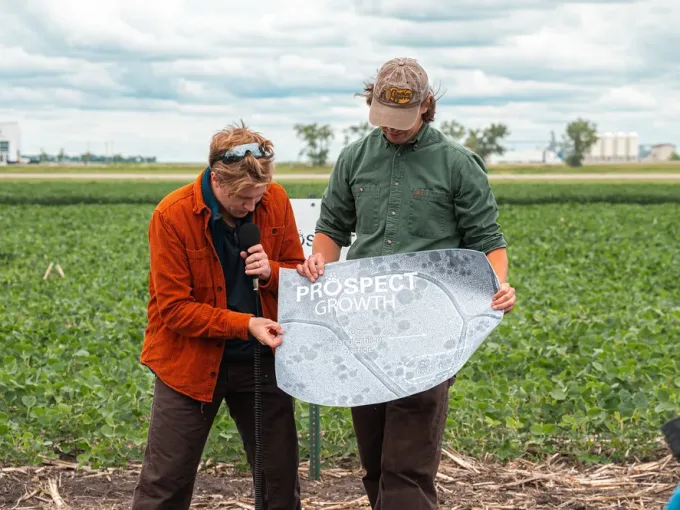
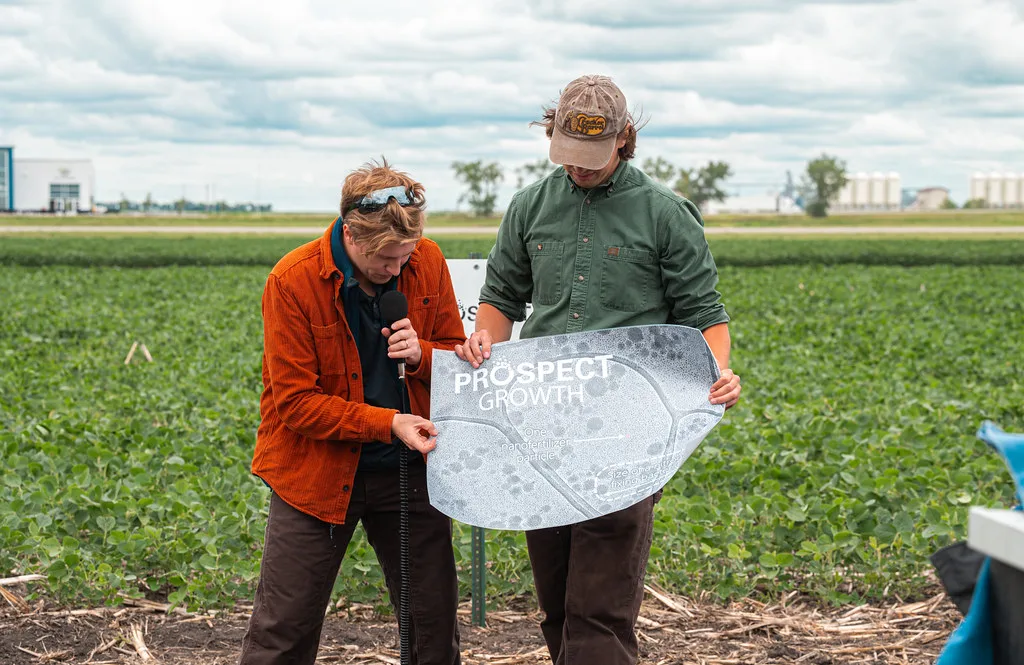
The 2025 field trial at Grand Farm evaluated Prospect Growth’s foliar-applied micronutrient nanofertilizers in soybeans grown under typical Red River Valley conditions.
The trial focused on comparing treated soybean plots with untreated control plots to evaluate potential performance differences.
A portion of the trial was designed to better understand whether the treatment might offer value beyond targeted rescue treatments for iron deficiency, particularly in fields where IDC occurs variably. This work was conducted in support of developing an IDC solution, though the trial itself was not conducted on plants actively expressing IDC symptoms.
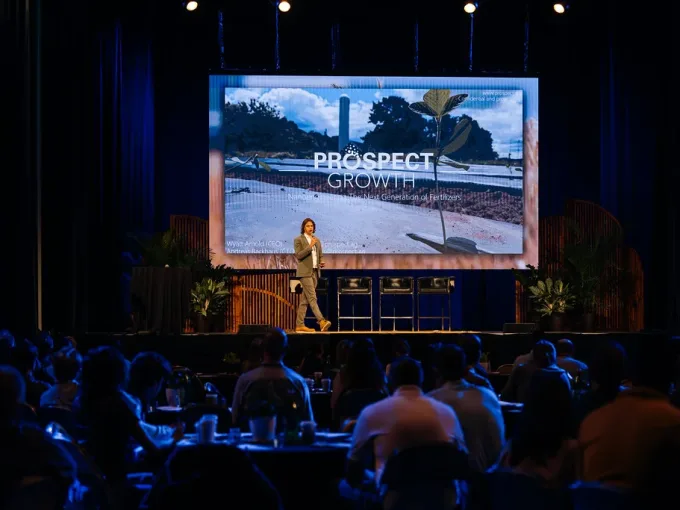
The field trial produced encouraging results for Prospect Growth’s nanofertilizer technology while also providing important insights into field variability and real-world performance.
A low-rate foliar application demonstrated a modest but positive yield response.
While early-stage, the results suggest the treatment may provide measurable agronomic benefits.
Researchers also observed improvements in several grain composition metrics in the treated soybeans:
These trends suggest the treatment may influence both yield and quality characteristics of soybean grain.
The trial confirmed that the nanofertilizer products were safe for soybean plants and compatible with existing farm equipment.
One of the materials tested consisted of solid nanoparticles suspended in liquid, and it was successfully applied using standard agricultural spray equipment without causing crop damage.
As with many agricultural trials, environmental variability influenced portions of the field site.
Residual effects from a prior-year corn trial and differences in precipitation across the plot created conditions that could influence results. Drone imagery and field observations helped identify these variations, allowing researchers to focus analysis on the most representative sections of the trial.
In addition to agronomic insights, the collaboration with Grand Farm created valuable opportunities for engagement with farmers and agricultural partners.
During Grand Farm’s field day events, Prospect Growth presented its technology to farmers and stakeholders visiting the innovation campus.
The partnership also helped Prospect Growth build relationships with growers interested in expanding trials beyond research plots.
The project also contributed to broader momentum for the company’s research efforts, including support from North Dakota’s Agricultural Products Utilization Commission (APUC).
“We loved the Field Days event where we got to present our plot and ideas to farmers and potential stakeholders. We received real commercial feedback, things like preferred formats and timing, which is incredibly helpful at this early stage.”
— Wyatt Arnold, Co-Founder & CEO, Prospect Growth
Encouraged by the results of the 2025 field trial, Prospect Growth plans to continue expanding its research efforts in the region.
Future work will focus on replicating the results across additional environments and further evaluating the technology’s potential for managing iron deficiency chlorosis in soybeans. The company is also exploring opportunities to scale testing through larger on-farm trials with growers in the region.
Through continued collaboration with Grand Farm and regional research partners, Prospect Growth aims to move its nanofertilizer technology closer to commercial adoption while helping farmers manage nutrient challenges more efficiently.
“Grand Farm has become a key partner for us in the agricultural heart of the U.S.”
— Wyatt Arnold, Co-Founder & CEO, Prospect Growth
Learn more about Prospect Growth
Learn more about Grand Farm