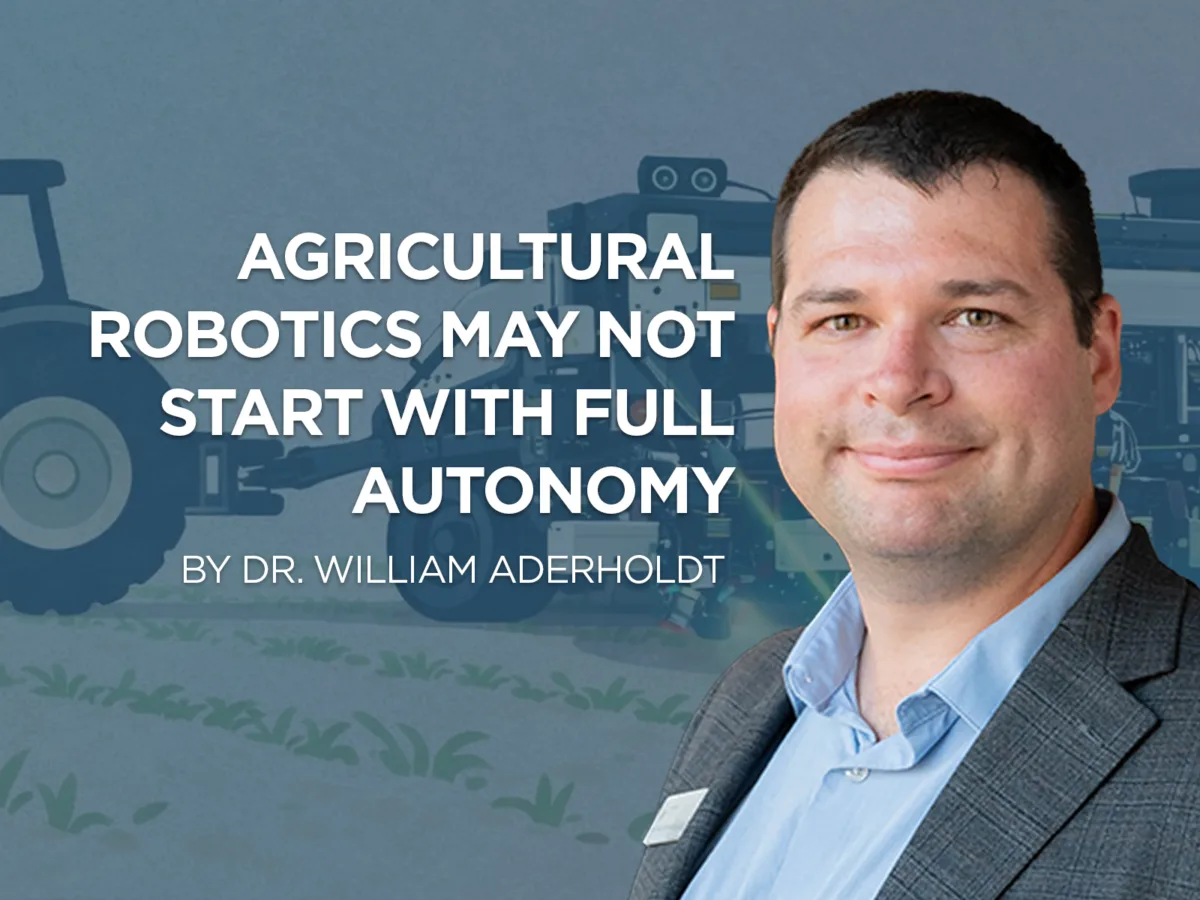
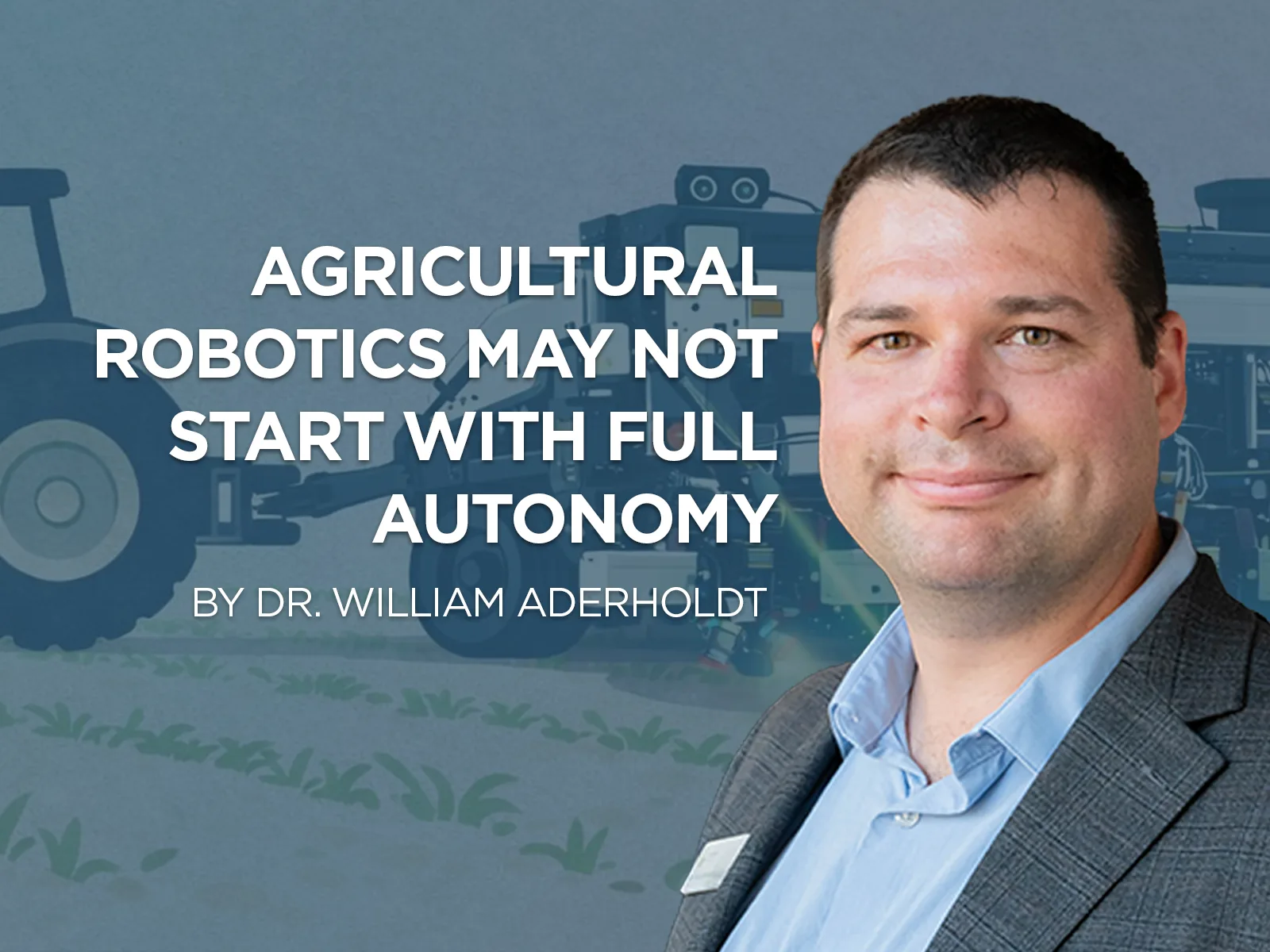
Dr. William Aderholdt serves as Executive Director of Grand Farm, a collaborative network advancing agriculture through applied technology. The views expressed in his writing are his own and do not necessarily reflect the positions of Grand Farm or its partners.
The path to agriculture robotics may not begin with full machine independence. It begins earlier, at the level of sensing and actuation.
At the University of Illinois Urbana-Champaign’s Center for Digital Agriculture’s Annual Conference, Mark Moran has coined this as “phase zero autonomy”: robotic systems that do not handle autonomous movement, object avoidance, or mission planning, but instead deliver highly capable perception and intervention while relying on human-guided mobility. In practice, this means many modern implements already function as robots. An individual planter row unit, for example, senses conditions, makes localized decisions, and executes actions with precision. The tractor supplies motion. The implement supplies intelligence and control.
That distinction matters. It suggests that agriculture may not need to solve every dimension of autonomy at once to unlock meaningful gains. In many cases, the most immediate value lies in improving what happens at the point of interaction with the crop, weed, or soil.
Precision Is Already Arriving Through the Implement
Recent advances in weed control illustrate the power of this model.
See-and-spray systems use sensors to identify weeds and apply herbicide only where needed. Their success depends heavily on geographic precision, but they can tolerate some variation in height relative to the target.
Laser weeding systems operate under a narrower margin of error. Effective weed destruction requires highly consistent distance to the ground and precise beam placement. That is one reason fixed-frame designs are attractive: they maintain alignment between sensing and actuation in a way that supports repeatable performance.
Mechanical weeding platforms present a related challenge. Systems that combine front-mounted sensing with targeted mechanical removal must repeatedly detect the weed, localize it correctly, and place the actuator accurately under variable field conditions. High efficacy depends not only on classification accuracy, but on repeatable physical execution.
These examples make clear that “robotics” in agriculture is not a binary distinction between autonomous and non-autonomous systems. It is a spectrum of increasingly sophisticated sensing and intervention capabilities, many of which already exist inside familiar implement architectures.
The Engineering Problem Is Context-Specific
The practicality of implement-centric robotics depends on the operating environment.
Farm type, terrain, acreage, labor availability, and required precision all influence what is viable. A system that performs well in specialty crops or smaller acreages may face different economic constraints in broadacre commodity production. The issue is not whether the technology works, but whether throughput, labor, and cost structure align with the realities of the farm.
Terrain is equally important. In uneven or hilly fields, maintaining consistent actuation height becomes more difficult. A rigid frame may be sufficient in flat ground, but contouring landscapes demand more adaptable architectures. Multi-section frames, articulated toolbars, or designs analogous to batwing mowers may be necessary to preserve target alignment across changing topography.
This is where the discussion must move beyond AI alone. Agricultural robotics is also a problem of structural engineering, frame dynamics, control systems, vibration management, and field durability.
Turning loads provide a good example. Implements experience asymmetric forces during turns: the inside corner compresses more, while the outside corner travels faster. Those dynamics can create misalignment, timing errors, and missed targets if not accounted for in both hardware and control logic. Precision intervention in the field requires more than detection. It requires a platform that can preserve precision under real operating stresses.
A Stronger Path May Be Separation of Functions
One of the most promising directions is a more modular industry architecture.
Rather than expecting each company to build a fully integrated system spanning movement, navigation, sensing, and actuation, the sector may benefit from greater separation of functions. In that model, one class of platforms would specialize in robust field mobility and navigation, while others would build interchangeable modules for tasks such as weed control, disease detection, nutrient placement, or biological application.
This approach offers several advantages.
First, it lowers integration barriers. Companies can innovate on sensing and intervention without needing to solve the entire autonomy stack.
Second, it improves reliability. Motion systems designed specifically for agricultural terrain, traction, and field logistics can become more durable and reusable across applications.
Third, it enables interoperability and upgradeability. A farmer or service provider could deploy different task-specific tools on a shared movement platform rather than purchasing an entirely new machine architecture for each use case.
That may be one of the most important strategic lessons of phase zero autonomy: the highest-value innovation may not come from replacing the whole machine. It may come from modularizing the machine and improving the intelligence of the working layer.
Why Phase Zero May Be Easier to Adopt
There is also an adoption advantage.
Farmers understand implements. They understand how they attach, how they behave in the field, how they fail, and how they fit into existing operations. That familiarity matters. It creates a base level of trust that fully autonomous systems often lack.
Phase zero systems can build on workflows that already exist. Farmers already make passes for herbicide, fungicide, cultivation, and nutrient application. An implement that introduces a new mode of action, whether mechanical, laser-based, or biologically targeted, can fit into those workflows more naturally than a wholly new autonomous operating concept.
That continuity lowers friction. It also creates a clearer path for education and demonstration. Stakeholders do not need to be convinced that robotics belongs on the farm. In many cases, they need to see that robotics is already there, embedded in the implements they use and understand.
The Economics May Also Be More Flexible
Phase zero systems may support business models beyond direct ownership.
If a specialized implement is only needed once per season, or only under certain weed or disease conditions, rental and service-based models may become attractive. That creates optionality for growers while allowing technology providers to concentrate utilization across multiple farms.
This matters in areas such as herbicide resistance management. A system does not need to replace every conventional pass to create value. If it reduces chemical use, preserves efficacy, diversifies modes of action, or improves control in high-pressure zones, it may justify adoption even at relatively low annual utilization.
That is an important shift in thinking. The value proposition is not always continuous autonomous operation. Sometimes it is precise intervention at the moments that matter most.
AI Will Matter Most Where It Improves Performance, Not Hype
AI will likely accelerate this category, but the most credible applications are practical.
AI can improve perception, calibration, targeting, control, and adaptation to changing field conditions. It can also shorten design cycles by helping engineering teams simulate failure modes, optimize layouts, and refine control strategies more quickly.
The real opportunity is not to append futuristic language onto agricultural robotics. It is to make these systems more robust, more adaptable, and easier to deploy in real production environments.
That is why phase zero autonomy is a useful concept. It focuses attention on what is already working, what is closest to scale, and where near-term technical progress can produce meaningful operational gains.
Conclusion
Phase zero autonomy offers a pragmatic framework for agricultural robotics. It recognizes that some of the most important advances in the field are already happening at the level of sensing and actuation, not just vehicle independence. See-and-spray, laser weeding, and precision mechanical intervention all show that robotics can create value within human-guided workflows.
The next step is not simply more autonomy for its own sake. It is better matching of implement design to field realities, stronger engineering for dynamic operating conditions, and greater modularity between movement systems and task-specific tools.
If the sector gets that architecture right, it can accelerate adoption, improve reliability, and expand the range of economically viable applications. In that sense, phase zero autonomy is not a compromise. It may be the most practical pathway to meaningful robotics adoption in agriculture.